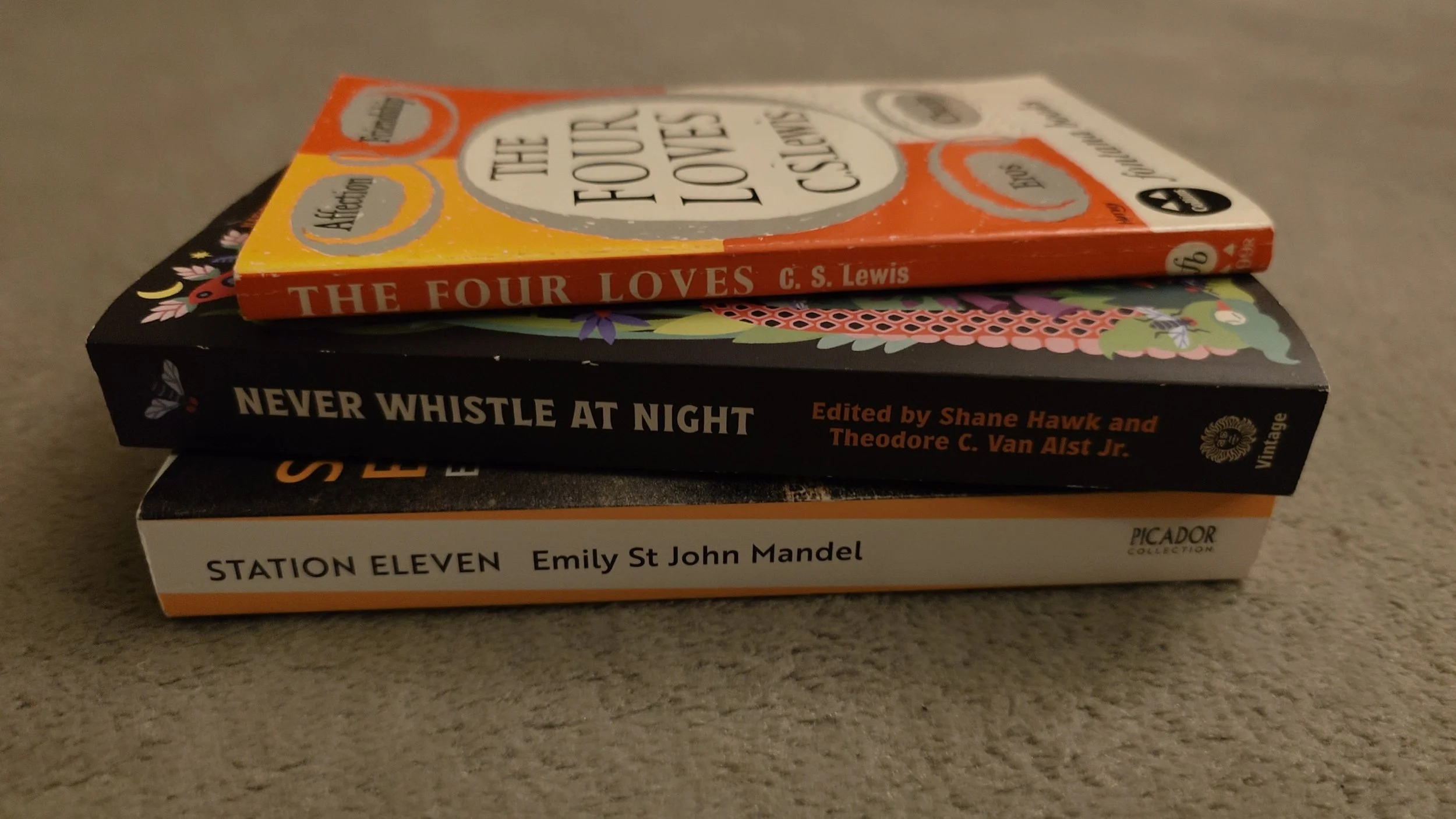
It’s taken me a while to get round to writing up July’s books; life has been occurring (mostly good!)
The Four Loves - C. S. Lewis
Yes, this is the lion, witch and wardrobe guy. No, this isn’t a kids’ book. A friend had been recommending CS Lewis’ writings on matters theological and philosophical, and I found this lurking on my shelf. I suspect I picked up in a second-hand shop, and then never got round to reading it.
“Even now, at whatever age, we all know the perilous charm of a shared hatred or grievance. (It is difficult not to hail as a Friend the only other man in College who really sees the faults of the Sub-Warden.)”
Why did I not get around to reading it? Well. I have always aspired to be the sort of person who reads philosophy, but I am incredibly bad at it. I have to concentrate very hard, and even then I often find I’ve consumed several pages where I definitely read all the words, but have somehow accrued no actual meaning.
On top of that, even if I do feel I’m following the author’s thoughts, they rarely stick, and so I end up in the situation I am in now: I know I read the book; I’m pretty sure I found some things of value in it; I’m blowed if I can tell you what they were.
Anyway. None of this is Mr Lewis’ fault as he does, on the whole, write very clearly. He is also writing from a different time, when attitudes to gender and sexuality were different; sometimes you can almost hear him struggling to be fair, sometimes bald statements don’t sit so well with today’s views.
I did, however, find a lot of his commentary on the “four loves” - affection, friendship, eros, and charity - to be easy to read, interesting, and with some unexpected takes on human nature. His writing on romantic love, in particular, surprised me - both in his open approach to relationships, and his theories around why sex is rarely the demon it can be made out to be. (I have since learned from Wikipedia that the essays were based on US radio talks, which were criticised in the late fifties for “their frankness about sex”.)
I do feel, though, that perhaps I should have taken notes. Most of the things that struck me as valuable have not, a month later, stayed with me.
Never Whistle at Night - Edited by Shane Hawk and Theodore C. Van Alst Jr.
This book is subtitled “An Indigenous Dark Fiction Anthology”. I bought it while on holiday in the Pacific North West almost two years ago (so the place it is indigenous to is North America). I like the idea of buying a book with some form of local connection when on holiday, and the excellent Powell’s City of Books in Portland had shelves and shelves of them for me to choose from.
“Everywhere he walked, he found arrowheads and crystals, snakes and snails, scanning constantly and missing nothing. He smoked like a chimney. He smiled a lot but hated photos, and in the few that were taken he’s just the top of a bowed head.”
One of the lovely things about short story anthologies is the variety, and bite-sized-ness. You can pick up a book, read a complete story, and still not be getting to bed too late on a schoolnight. The voices are different, the settings are different - and if there’s a story you don’t enjoy so much? Never mind, there’ll be a new one along in a couple of pages.
There’s a lot of great writing to enjoy in this collection. Some of the descriptions have stuck with me really vividly - like Joe’s reaction to the blazingly sexy Cam turning up at the start of Conley Lyons’ Navajos Don’t Wear Elk Teeth, or the narrator’s flat delivery of the facts of her brother’s death in Carson Faust’s Eulogy for a Brother, Resurrected.
There’s also a lot of variety in the “dark” - dark magic, political darkness, personal trauma and just plain unsettling. One of the stories I’d file under “didn’t enjoy so much” seemed a little too close to a catalogue of tortures inflicted on a person for fairly vague reasons. My favourite (Kate Hart’s Uncle Robert Rides the Lightning) was a deeply weird cosmic tail of a man looking out for his kin. I’m pretty sure there’s something for everyone.
Reading this also made me uncomfortably aware how “white” my reading list usually is. I must make more effort to pick up books written from a wider range of viewpoints.
Also: the physical book itself is weirdly… floppy. It falls open, naturally, into an easy-to-read position. Is this some wizardry of American book-binding? Can we have books in the UK that are this obliging, please?
Station Eleven - Emily St John Mandel
This book plopped most unexpectedly through my letterbox in mid-July. Friend C had enjoyed it, and put in the post with a letter as she thought I might like it, too. (This, by the way, is something C has been doing for years, and it is an utterly fabulous habit. Next time you finish a book, consider sending it to a bookish friend. Who doesn’t love an unexpected book and letter in the post?)
““It’s just an awful thing to do.”
”I don’t think I’m an awful person,” Elizabeth says.
”No-one ever thinks they’re awful, even people who really, actually are. It’s some sort of survival mechanism.””
C described Station Eleven as being “about a pandemic (sort of), but not our pandemic”. It opens with the spread of a highly-contagious, deadly flu virus sweeping across the world and generally shutting down civilisation as we know it. It was published in 2014. (And quite frankly, given how the book-pandemic plays out, I’m pretty glad I hadn’t read it when Covid kicked off.)
We all know how post-apocalyptic books go, no? There will be foraging for food and equipment, trying to get things working, probably some stockpiling of weapons, maybe marauding bands… honestly, fairly tedious. The thing that makes Station Eleven amazing is that it has all of those, but they’re sort of nothing to do with the plot. They’re the backdrop, sure, and they have quite an impact on the characters, but they are fundamentally not what the book is about.
What it is about is people, and relationships, and the role of art in a society that is scrabbling for survival. Did I mention that quite a lot of the post-apocalyptic action takes place in a travelling Shakespeare company? The writing is sharp, and beautifully observed, and incredibly compelling to read. Pretty sure I polished this off in a weekend.