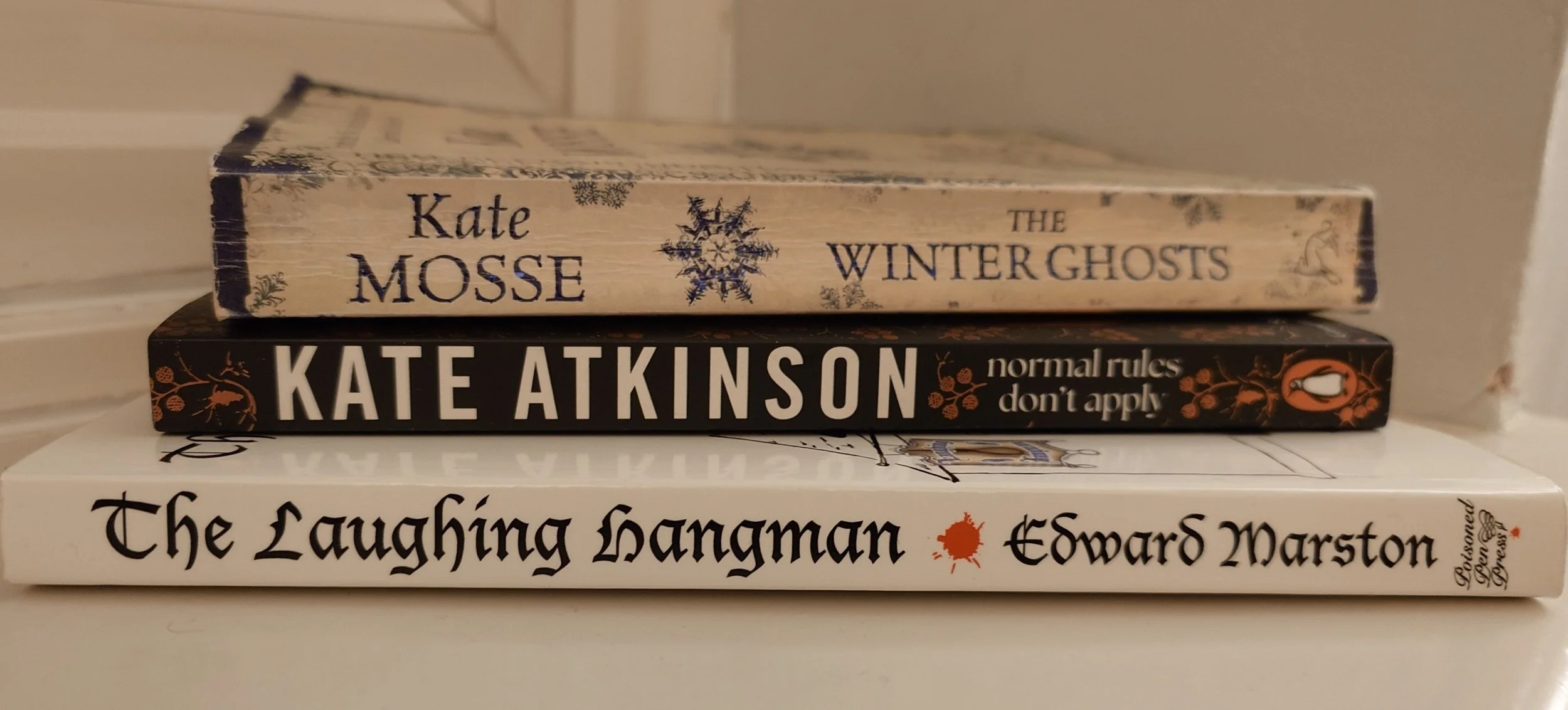
Normal Rules Don’t Apply - Kate Atkinson
I bought this book last summer, because I was in a small Oxfordshire town with a very lovely independent bookshop and I had some time to kill. And when you’ve walked in and looked at all their books, it becomes just plain rude not to buy one.
Especially when they’ve put books with beautifully pretty foiled covers out. In stacks. On tables.
“He had recently moved back home. Or ‘Nick’s living at home again!’ if you put a sparkle on it. And, believe me, Pamela tried to.”
Anyway. Normal Rules Don’t Apply is a collection of short stories - Kate Atkinson’s first new collection in twenty years, according to the cover blurb. I absolutely love Kate Atkinson’s novels, and was really looking forward to this.
Spoiler: I was rather disappointed. The stories are described as “interconnected tales”, and it is certainly true that characters and motifs pop unexpectedly from one to the next. However, I had two big gripes…
Firstly, the stories weren’t, individually, all that satisfying. Several of them seemed just to… stop, rather than end. Possibly the problem here is that it’s a while since I’ve read much literary short fiction, and genre stories do tend to set a rather higher bar for tidy plot resolution. Secondly, taken all together, I couldn’t really come up with a particularly coherent over-arching story, either. Which is doubly annoying because it’s a disappointment and also makes me feel like perhaps I am just a bit stupid and missing something.
Anyone used to Atkinson’s novels will not be surprised to learn that massively implausible, unexpected things happen all over the place - it’s one of the things I like about her work. Some of the characters are gods, or plants, or talking dogs; some are barely mentioned, some are creating the world around them. I loved the chaos, and the writing is, of course, beautiful, sharp and witty. I enjoyed the journey of many of the stories. I just didn’t necessarily like the destination all that much when I got there.
The Winter Ghosts - Kate Mosse
I was about half a chapter into this - and trapped in a situation with no other reading options - when I realised I'd read it before, and fairly recently. Fortunately, I liked it first time round.
“But there was something about the stillness of the afternoon light, the ambience of being down-at-heel, that I liked, like a photograph of a one-fashionable destination that had now grown old and tired.”
It's a rather lovely story - containing actual ghosts and actual winter - of a young man who fell apart after the First World War, despite having not fought in it. Desperate to escape his own loneliness, and unable to join in the collective moving-on that everyone else has decided is the correct approach, he drives aimlessly through Europe and accidentally falls into a strange tale in an all-but-forgotten town.
The pace is slow and contemplative as the protagonist relates it, within the framing device of a visit to an antiquarian bookseller. It is also, I think, fairly obvious to the reader what is happening throughout - and that is intentional, as the author plants a big yellow cross of a clue quite early on.
There are no big reveals or shocking moments, and I’d file this more as a gentle exploration of grief than a story of adventure and discovery in the mountains.
This Way Up: When Maps Go Wrong (and Why it Matters) - Map Men
“You can brag all you like about the time you found a stationery shop in a medium-sized town even though your phone had run out of battery, but until you find yourself navigating without so much as a compass between tiny low-lying islands hundreds of miles apart in a featureless ocean so large it could fit every land continent inside it and still have room for another Russia, you’ll only ever be a worthless orienteering novice.”
As a long-time follower of the Map Men on YouTube, I was very excited about this book coming out. Around October-time I realised that there was a grave risk everyone would buy me it for Christmas, and warned a couple of people off. As a result, nobody bought me it for Christmas.
However, I bought it for my dad for Christmas, and thus read his copy on a recent visit home. Which is excellent, because it’s like owning a book, but you don’t have to find shelf space for it. See also: libraries. (This is why this book is missing from the pile in the picture.)
Anyway. As hoped, I absolutely loved this. It’s extremely entertaining, and full of all sorts of interesting titbits of information (which I am now regurgitating relentlessly to anyone who will listen). Did you know about the Mountains of Kong, the impassable mountain range that appeared on maps of Africa for more than a century despite not existing?
There were a couple of chapters with slightly odd conceits (one the transcript of an imaginary podcast, and one a series of letters from the man who conceived the The Millionth Map) which I found dragged a little bit, but other than that: genuinely informative, genuinely fun.
The Laughing Hangman - Edward Marston
Having finished the Map Men’s book, I went questing around my parents’ house for something to read (not a very challenging quest, to be honest). In one of the many “out” piles of books (going to the charity shop, the church bookstall, various friends, etc) I found this, and pulled it out because I thought the title was intriguing.
“The joy of seeing Anne again had been vitiated by the annoying presence of an interloper. ”
The book had a rather low-rent vibe, but I’ve read and enjoyed some of Edward Marston’s Railway Detective stories, so I decided to risk it. The Laughing Hangman is some way into another of his historical detective series, this time featuring crimes solved by Nicholas Bracewell, a member of an Elizabeth troupe of players.
Sadly, this novel is dreadful. The dialogue is wooden, the characters unconvincing, and the plot is silly. The resolution comes out of nowhere, with no real attempt to seed clues for the reader or tie the disparate plot-strands together, and the whole thing comes off as something that was just churned out to meet a word-count.
Also, either the author has an impressive vocabulary (but no sense), or he writes with a thesaurus in one hand. I had to look up a couple of words. On the plus side, I discovered that “vitiated” doesn’t mean what I thought it did - spoiled or impaired, apparently, and nothing to do with being brought to life. At least I learned something!