A couple of years ago, I was writing a story.
That story—which grew into a horror novelette—was ultimately published by Graveside Press. Did I mention? You can get an e-book or a lovely, very slim, real-live-paper-book version from many booksellers. If you’re in the UK, you can also order it from real, proper booksellers like Waterstones and Blackwells (and apparently some independents), though I am not aware of any shops carrying it on shelves in-store. This is the first time someone has published a book that has only my words in it, and I have no chill about it whatsoever. Also, people seem to like it!
But I digress. At the end of 2023, I was writing the first, rough draft. With a pen, in a notebook. The two main characters—teenagers in the late 80s—were bonding over a shared love of music, glued to their personal stereos, swapping albums and mixtapes. Then they went to Heather’s house, and shoved a tape into the…
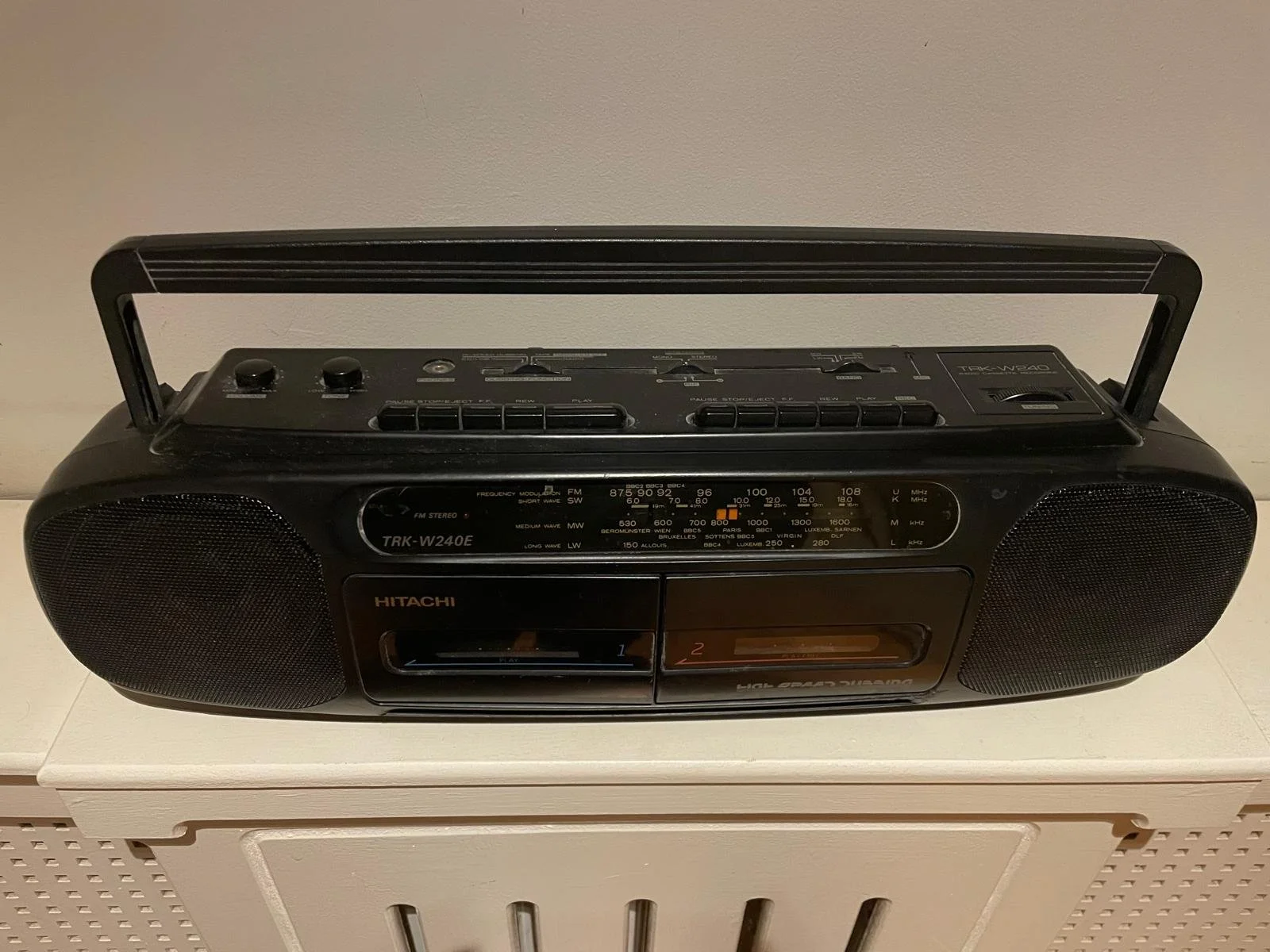
A classic portable stereo of exactly the type I am trying to describe. This one belongs to my friend Charlotte, who kindly sent me a photo.
Yes. Now. I’ve written here before about how important I think it is to keep an authentic voice when writing. I was a teenager in the 80s. I wanted the characters to speak, in so far as I could remember, the way I and my contemporaries did. But I’d hit a problem.
I knew exactly what I wanted Heather’s stereo to look like. Twin tape decks in the middle, and speakers on the ends. Plastic. Long handle over the top. A retractable radio aerial at one corner. Something you could plug into the mains, or put a stack of batteries in and carry outdoors. I also knew exactly what I would have called it. What absolutely everyone called it.
Unfortunately, that name was… kinda racist. Having grown up with the name, I’d always used it without thinking until my friend Rhi pulled me up on it a few years ago. Worse, I wasn’t even sure I knew another name. Certainly not one that would instantly bring exactly the right kind of portable stereo to mind.
After some preliminary googling, I asked the nearest person of a similar age what he would have called this kind of stereo in the 80s. His name was considerably more racist than the one we used. Eventually, I gave in and googled “proper name for a ——”, and came up with “boombox”.
I dithered over this for a long time. I didn’t like boombox as an alternative. It’s not a word I used, or heard, or even really know. Should I stick to the 80s? The other name was ubiquitous and (in my case) used without any racist intent—or, to be honest, even any awareness that it might be offensive. It was even used as an actual model name by one manufacturer in the 80s, so surely it wasn’t that bad? But, you know, I know now. And racism so engrained you don’t even notice it isn’t exactly better than any other kind. The stereo was integral to the story and couldn’t be quietly replaced with a record player or a telly, so boombox it is.
Would it have made a huge, material difference if someone had published a novelette, with a small press, that used a somewhat racist term from the 80s? No. But sometimes, there are more important considerations than authenticity.
(But if anyone’s got any good, period-authentic names for boomboxes, I’d love to hear them!)
Some of you at this point may be thinking “all this fuss about the boombox, and yet throughout the novelette—and in your opening paragraph here—you have cold-bloodedly used the phrase personal stereo?”
I hear you. I would certainly have called mine a Walkman, despite none of the various “Walkmen” I owned having been manufactured by Sony. I had a little struggle over this one, too, wondering whether misusing trademarked names was an issue I needed to care about. But we see the story through Stuart’s eyes, and he is exactly the geeky, pedantic sort who probably would have referred to his off-brand knock-off as a personal stereo.
Had Heather ever mentioned hers, she would 100% have called it a Walkman.