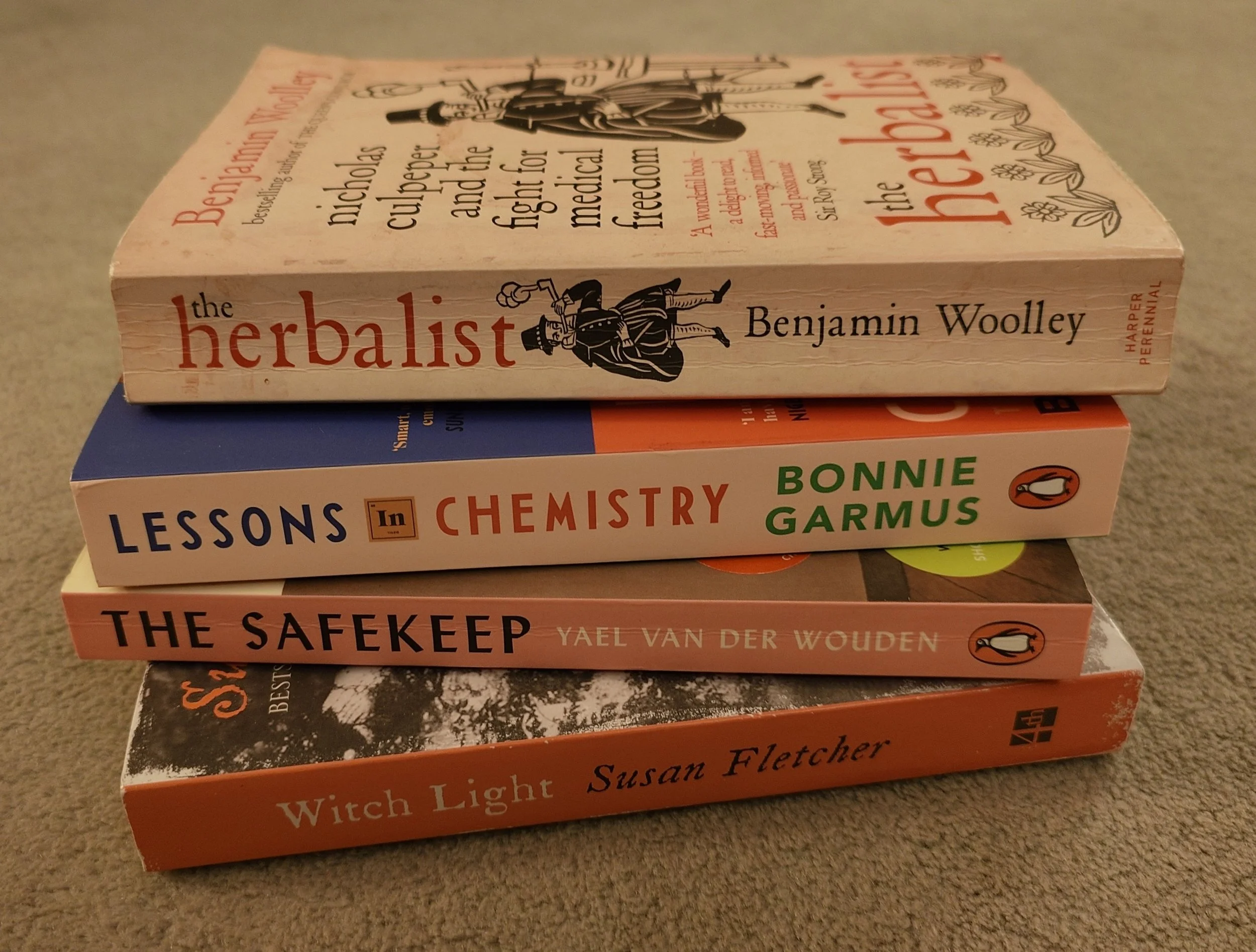
At the end of last year, I spent a few days sitting on the sofa reading. And I thought hey, you know what? I really like reading. I should do more of it!
I thought I might also try and note down the books I read, and what I thought of them. So here we are! The books I read in January…
Witch Light - SUsan Fletcher
I bought this in 2024, on a visit to the delightful Mr B’s Emporium in Bath. Mr B’s is one of those bookshops that has a genius for piling up books in a way calculated to maximise how incredibly appealing they look, and it’s rare that I manage to escape their clutches without a couple of new books.
“Five days after Hogmanay, a wind blew in... Skies swelled and raced, like seas-skies do. And I wandered - for wasn’t winter always too magick to go unseen?”
Witch Light follows a young woman, imprisoned as a witch in 17thC Scotland. The text alternates between her life story, and the letters that the vicar to whom she’s telling it writes home to his wife. As soon as I started it, I thought I’d made a duff choice of book. I found Corrag’s speaking style so mannered and ungainly, that a whole book of it seemed like dreadfully hard work. However! Within a few chapters I was completely won over, and I absolutely loved it.
Corrag has lived most of her adult life in the open, in caves, or on the run. Her descriptions of the wild Scottish landscape and her long rambling accounts of how she views the world are beautiful. Sitting at home, in a cold and damp January, I kept finding myself envious of the wide, white Glencoe winter. Even bathing in an ice-filled burn seemed suddenly appealing.
This is an interesting story, based (if rather loosely) on real people and events - but the writing alone makes it worth a read.
The Safekeep - Yael van der Wouden
Some friends were passing books around recently, and this was being returned to its owner. Everyone who’d read it agreed it was fantastic, the sort of book that you have to read again the instant you finish it. I hadn’t realised how zeitgeisty it was - or that it was shortlisted for the Booker. Nothing fills me with dread, literarily, like the phrase “the Booker Prize”. Given that inauspicious beginning, I enjoyed it a lot more than I expected to.
“Sometimes she’d disappear for a while. Sometimes she’d be everywhere all at once. Her perfume bullied itself around the house.”
The Safekeep is the story of Isa, a young Dutch woman who lives alone in her family home. I did wonder, partway through, whether it was translated from Dutch - something about the writing style gives it a translated feel. (The answer is “no”, the author is trilingual and writes in English - though she was also involved in the Dutch translation.)
The writing is, again, beautiful. It’s quite spare, and choppy, and conjures up very vivid images in quite short sentences as it describes Isa - isolated and unhappy - struggling with an unwelcome and unwanted house guest, and numerous echoes of her family’s past.
Set in the Netherlands, in 1960s, it also follows a thread of history I knew very little about: the country’s treatment of its Jewish population during, and after, the Second World War.
I enjoyed the journey of this book, but found the end a little unsatisfying. It feels rushed, and like a conjuring trick that hasn’t quite come off properly because the audience saw one of the wires. I’d still recommend it, though, for some interesting writing - especially around making rather unlikeable characters relatable - and for the story overall.
Lessons in Chemistry -Bonnie Garmus
Because I am a pop-culture desert who lives under a rock, I’d never heard of Lessons in Chemistry - neither the book nor the TV miniseries - when a friend gave me it as a late birthday present. The book has won a number of “book of the year” style awards, was not shortlisted for the Booker (as far as I know) and is an incredibly fun read.
““Dolphins are smart,” they’d say. “But cows aren’t.” This seemed partly based on the fact that cows didn’t do tricks. In Six-Thirty’s view that made cows smarter, not dumber. But again, what did he know?”
Here we have Elizabeth Zott, a scientist who is just trying to do science in 1960s America, but running into obstacle after obstacle due to the terrible affliction of being female. She’s very smart, she’s a great scientist, she has a cutting answer for everything - and, by and large, her male bosses are having absolutely none of it. Oh, she’s also pretty - and quite a lot of them do want a bit of that, often in the ugliest manners possible.
I ripped through this book incredibly quickly, and only afterwards realised that there was something about it that didn’t quite sit right with me. Something about the way the plot unfolded just felt a little bit too pat, a little bit too convenient. Nothing felt quite plausible and realistic. And no, it absolutely wasn’t the sudden arrival halfway through the novel of the talking dog - in fact, Six-Thirty was one of my favourite characters. It was almost everything else that had a weird and slightly artificial vibe - I think this must have been a deliberate choice from the author, as it is very consistent throughout.
It is, however, very funny. Just accept that everything’s going to be a little odd, and jump on for the ride!
The Herbalist - Benjamin Woolley
It feels a little cheaty to claim this under January books, because I’m pretty sure I started it last summer. I’m not entirely sure why it took me so long to finish it, given that I really enjoyed it.
“Prosecutions of unlicensed publishing was implemented with speed... as though the clock had been turned back twenty years... There was just one annoying difference. Nicholas Culpeper’s “English Physitian” continued in print, and would remain in print for centuries...”
The Herbalist is a biography of Nicholas Culpeper, which is only slightly hampered by there being extremely minimal information about the man who wrote the famous Culpeper’s Herbal. At the end of the book, I still didn’t feel like I had a terribly strong sense of who Culpeper was.
What I did have, however, was a staggering amount of background information. After covering Culpeper’s early life, we’re plunged into chapters about the stranglehold the Guild of Surgeons had on the practice of medicine in London, how apothecaries were incredibly tightly controlled, how sharing information could be prosecuted as sedition, and how the Civil War, royalist allegiances and the practice of astrology all rolled up to make publishing the books Culpeper did extremely dangerous.
Culpeper’s story is as much about power struggles and political manoeuvring as it is about herbs. But the books he published - in English, not Latin, and with explanatory footnotes that blew medical “secrets” open to anyone who could read - democratised access to information and changed the face of medical practice.
I love the English Civil War as a historical period, but mostly I’ve read about the radical thinkers and progressive religious sects. I actually knew very little about Charles’ court or the effect that the back-and-forth of the factions had on the everyday life of a London merchant.
Not a light read, but very painless for the amount of information it contains!