reading

2026 in Books: February

Well, having started strong with 4 proper-length novels in January, February has been a little busy, so I’ve read rather less.

In my defence, I finished a book on Sunday, so if February was a proper-length month I’d have squeezed in another. Ah well, at least I’ve got a headstart on March!

A small pile of all the books mentioned in the post, piled up on a grey carpet.

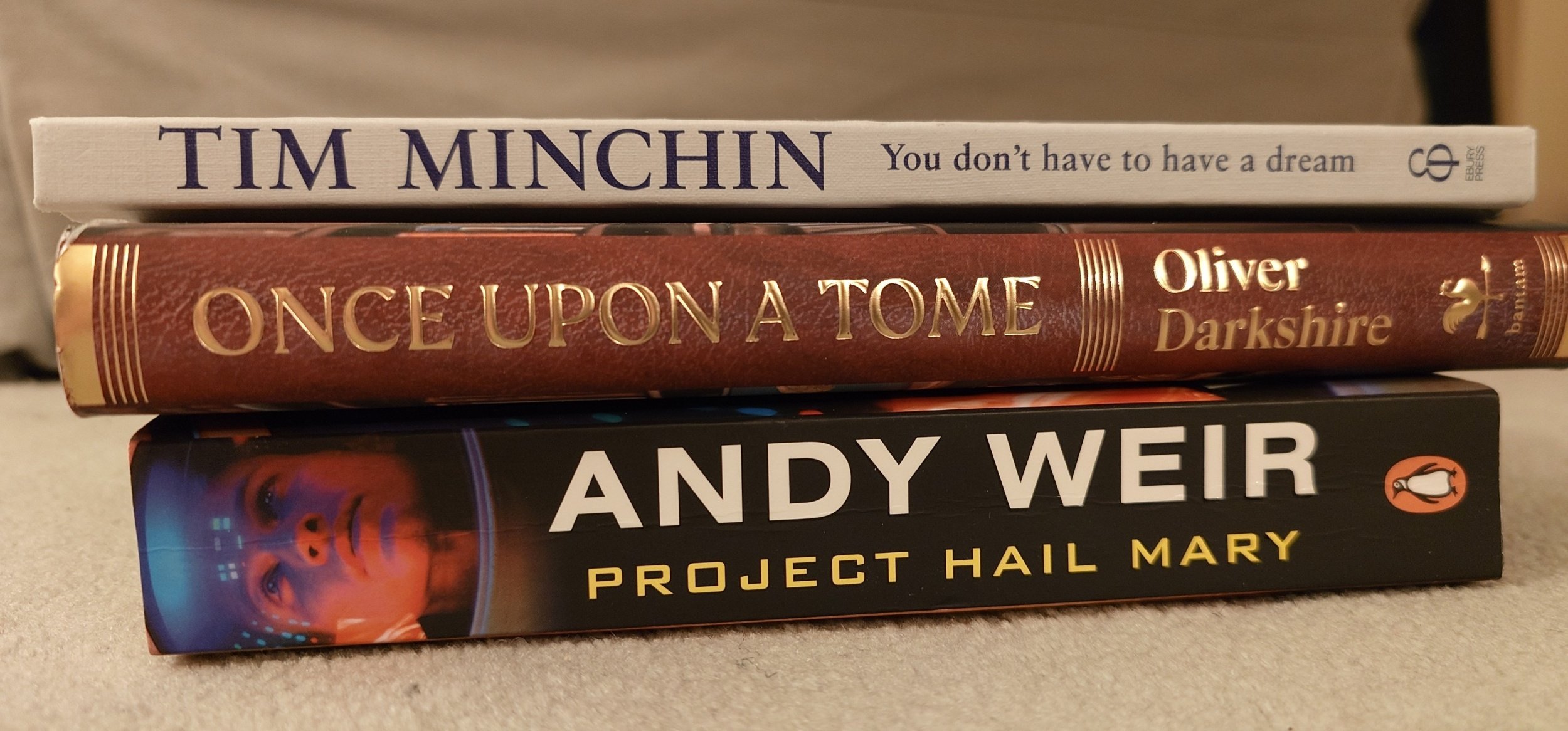
Project Hail Mary - Andy Weir

Project Hail Mary was a Christmas present from one of my most reliable book-choosing friends. She usually skews more towards fantasy (at least in her presents to me), so I was mildly surprised to find myself unwrapping what was patently going to be reasonably hard sci-fi. And set in space. I often don’t get on well with books set in space. But, like I said, she’s very reliable.

I have four rough circles, each a couple of inches across. Yes, inches. When I’m stressed out, I revert to imperial units. It’s hard to be an American, okay?
— Project Hail Mary

And everyone liked The Martian, right?

It was, of course, fine. The books cracks along at a tremendous pace, manages not to have vast tracts of turgid prose about the insides of spaceships, and is broadly speaking very silly.

Dr Grace - our unlikely space hero, suffering from amnesia and inexplicably solo on a large spaceship - has a very lightweight, chatty narration style that is incredibly easy to read.

We do, over the course of his adventures, get moderately vast tracts of space logistics, some of which I found a little difficult to follow - but I think that’s on me. I usually can’t keep up if anyone describes a layout more complicated than a small potting shed.

The story does use the same device over and over again: Dr Grace has a problem! Dr Grace can jury-rig himself a solution using a thing that is already on the ship, some alien tech and a lot of maths! He is basically a one-man A-Team In Space.

But… while I wouldn’t like to stand bail for all the solutions being completely plausible, they are plausible enough. They feel like a bunch of little puzzles with very satisfying conclusions. Anyway, the cover-blurb says Tim Peake liked the book, which seems good enough to me.

Despite my space-based misgivings, this book was massive fun.

Once Upon A Tome - Oliver Darkshire

This book - also a Christmas present - is subtitled “The Misadventures of a Rare Bookseller”. I suppose technically it is non-fiction, but it is another very quick, easy and entertaining read.

Unlike other disciplines, book cataloguing is less an art, not really a science, and more of a completely unstandardized, decentralized carnival fire.
— Once Upon A Tome

In a series of very short chapters (which are the absolute devil for making readers think “ok, just one more, then I’ll…”) the author recounts the deeply peculiar - and probably mostly true - life of an apprentice at a shop which claims to be the oldest bookshop in the world. (At least he says it did at the time, its website now claims, slightly more circumspectly, that it is “the longest-established rare book dealer in Europe”.)

If you are the sort of person who likes hanging around in second-hand bookshops, and sincerely wish to believe that all booksellers are mad as hatters, shuffling about in a sort of genteel chaos of incunabula and stuffed owls, trying to avoid both demanding customers and cursed volumes, then you should read this book.

If you know that sort of person, and never quite know what to give them as a present, give them this book.

I assume that lawyers have been involved and none of the stories are actively libellous, but there is a pleasing vibe of scurrilous gossip throughout. Grab a drink, find a comfy chair, and prepare to be entertained.

You Don’t Have To Have a Dream - Tim Minchin

Which is your job (just by the way):
To put into the world valuable ideas.
— Tim Minchin

This is yet another very quick read - as a book it’s on the slim side, but more relevantly it’s big print, and big illustrations. The content is the transcripts of three speeches Minchin has given, each one on the occasion of receiving an honorary degree. One of which is a long-form poem.

Some of it is advice on being an artist. Some of it is suggestions of how to live better. Some of it is a bit angry, and some of it is funny, and all of it is very easy to understand and expressed with a lot of heart.

It feels like it would be pretty decent life advice for a child, though it depends how comfortable you are with your child reading the word fuck occasionally.

2026 in Books: January

A pile of paperback copies of the books discussed in this blog post.

At the end of last year, I spent a few days sitting on the sofa reading. And I thought hey, you know what? I really like reading. I should do more of it!

I thought I might also try and note down the books I read, and what I thought of them. So here we are! The books I read in January…

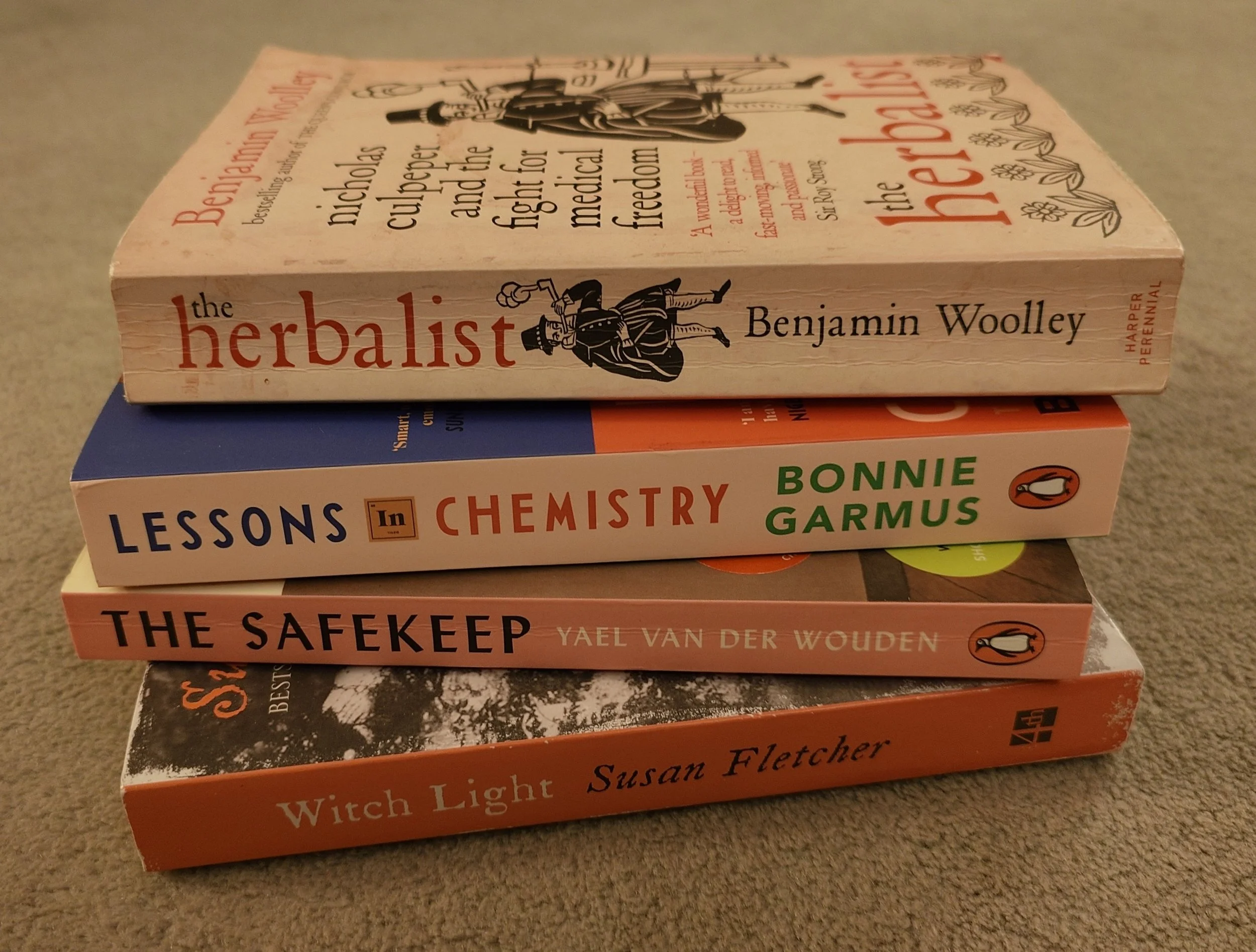
Witch Light - SUsan Fletcher

I bought this in 2024, on a visit to the delightful Mr B’s Emporium in Bath. Mr B’s is one of those bookshops that has a genius for piling up books in a way calculated to maximise how incredibly appealing they look, and it’s rare that I manage to escape their clutches without a couple of new books.

Five days after Hogmanay, a wind blew in... Skies swelled and raced, like seas-skies do. And I wandered - for wasn’t winter always too magick to go unseen?
— Witch Light

Witch Light follows a young woman, imprisoned as a witch in 17thC Scotland. The text alternates between her life story, and the letters that the vicar to whom she’s telling it writes home to his wife. As soon as I started it, I thought I’d made a duff choice of book. I found Corrag’s speaking style so mannered and ungainly, that a whole book of it seemed like dreadfully hard work. However! Within a few chapters I was completely won over, and I absolutely loved it.

Corrag has lived most of her adult life in the open, in caves, or on the run. Her descriptions of the wild Scottish landscape and her long rambling accounts of how she views the world are beautiful. Sitting at home, in a cold and damp January, I kept finding myself envious of the wide, white Glencoe winter. Even bathing in an ice-filled burn seemed suddenly appealing.

This is an interesting story, based (if rather loosely) on real people and events - but the writing alone makes it worth a read.

The Safekeep - Yael van der Wouden

Some friends were passing books around recently, and this was being returned to its owner. Everyone who’d read it agreed it was fantastic, the sort of book that you have to read again the instant you finish it. I hadn’t realised how zeitgeisty it was - or that it was shortlisted for the Booker. Nothing fills me with dread, literarily, like the phrase “the Booker Prize”. Given that inauspicious beginning, I enjoyed it a lot more than I expected to.

Sometimes she’d disappear for a while. Sometimes she’d be everywhere all at once. Her perfume bullied itself around the house.
— The Safekeep

The Safekeep is the story of Isa, a young Dutch woman who lives alone in her family home. I did wonder, partway through, whether it was translated from Dutch - something about the writing style gives it a translated feel. (The answer is “no”, the author is trilingual and writes in English - though she was also involved in the Dutch translation.)

The writing is, again, beautiful. It’s quite spare, and choppy, and conjures up very vivid images in quite short sentences as it describes Isa - isolated and unhappy - struggling with an unwelcome and unwanted house guest, and numerous echoes of her family’s past.

Set in the Netherlands, in 1960s, it also follows a thread of history I knew very little about: the country’s treatment of its Jewish population during, and after, the Second World War.

I enjoyed the journey of this book, but found the end a little unsatisfying. It feels rushed, and like a conjuring trick that hasn’t quite come off properly because the audience saw one of the wires. I’d still recommend it, though, for some interesting writing - especially around making rather unlikeable characters relatable - and for the story overall.

Lessons in Chemistry -Bonnie Garmus

Because I am a pop-culture desert who lives under a rock, I’d never heard of Lessons in Chemistry - neither the book nor the TV miniseries - when a friend gave me it as a late birthday present. The book has won a number of “book of the year” style awards, was not shortlisted for the Booker (as far as I know) and is an incredibly fun read.

“Dolphins are smart,” they’d say. “But cows aren’t.” This seemed partly based on the fact that cows didn’t do tricks. In Six-Thirty’s view that made cows smarter, not dumber. But again, what did he know?
— Lessons in Chemistry

Here we have Elizabeth Zott, a scientist who is just trying to do science in 1960s America, but running into obstacle after obstacle due to the terrible affliction of being female. She’s very smart, she’s a great scientist, she has a cutting answer for everything - and, by and large, her male bosses are having absolutely none of it. Oh, she’s also pretty - and quite a lot of them do want a bit of that, often in the ugliest manners possible.

I ripped through this book incredibly quickly, and only afterwards realised that there was something about it that didn’t quite sit right with me. Something about the way the plot unfolded just felt a little bit too pat, a little bit too convenient. Nothing felt quite plausible and realistic. And no, it absolutely wasn’t the sudden arrival halfway through the novel of the talking dog - in fact, Six-Thirty was one of my favourite characters. It was almost everything else that had a weird and slightly artificial vibe - I think this must have been a deliberate choice from the author, as it is very consistent throughout.

It is, however, very funny. Just accept that everything’s going to be a little odd, and jump on for the ride!

The Herbalist - Benjamin Woolley

It feels a little cheaty to claim this under January books, because I’m pretty sure I started it last summer. I’m not entirely sure why it took me so long to finish it, given that I really enjoyed it.

Prosecutions of unlicensed publishing was implemented with speed... as though the clock had been turned back twenty years... There was just one annoying difference. Nicholas Culpeper’s “English Physitian” continued in print, and would remain in print for centuries...
— The Herbalist

The Herbalist is a biography of Nicholas Culpeper, which is only slightly hampered by there being extremely minimal information about the man who wrote the famous Culpeper’s Herbal. At the end of the book, I still didn’t feel like I had a terribly strong sense of who Culpeper was.

What I did have, however, was a staggering amount of background information. After covering Culpeper’s early life, we’re plunged into chapters about the stranglehold the Guild of Surgeons had on the practice of medicine in London, how apothecaries were incredibly tightly controlled, how sharing information could be prosecuted as sedition, and how the Civil War, royalist allegiances and the practice of astrology all rolled up to make publishing the books Culpeper did extremely dangerous.

Culpeper’s story is as much about power struggles and political manoeuvring as it is about herbs. But the books he published - in English, not Latin, and with explanatory footnotes that blew medical “secrets” open to anyone who could read - democratised access to information and changed the face of medical practice.

I love the English Civil War as a historical period, but mostly I’ve read about the radical thinkers and progressive religious sects. I actually knew very little about Charles’ court or the effect that the back-and-forth of the factions had on the everyday life of a London merchant.

Not a light read, but very painless for the amount of information it contains!

Looking For "The Drop" in Horror Fiction

 
Grainy, distorted, monochrome image of a white female in a black hood.
 

Many years ago, when I was at university, I wandered into a room where a friend was looking at a picture. I don’t remember if it was a photograph, or an illustration in a book; it’s a sufficiently long time ago that it probably wasn’t on a screen.

Anyway, I looked over his shoulder at the picture: a fancy, black, metal gate. Across the gateway’s arch, large letters spelled out “Arbeit Macht Frei”. I looked at the picture, and I laughed.

(You may already be running ahead in this story; stick with me.)

My friend asked why I was laughing.

Well, I explained. I’d always thought that sort of attitude - the mindset that built gateways for The Poor Working Class and put Improving Moral Epithets over them - was peculiar to Victorian Britain. To the nineteenth-century mill- and mine-owners who, simultaneously exploitative and paternalistic, squeezed workers dry while espousing the merits of hard work, and self-improvement. The practice of putting these slogans on doorways and arches was something I’d always found grimly amusing.

And - now - apparently it wasn’t just Britain. Even in Germany, there had been equivalent factory-owners who probably disregarded safety and paid their staff a pittance even as the gateway promised that Work Sets You Free. I imagined the owners waffling into their handlebar moustaches and congratulating themselves on the excellent opportunities they afforded the local labourers. See, if you just work a little harder for a little less money, your opportunities will be endless! If you die poor, it is because you didn’t work hard enough!

My friend - whose Jewish father had fled Europe in the late 1930s, and whose aunts and cousins had not and had died in concentration camps - said to me: you do know that this is the gateway to Auschwitz?

No, I had not known.

“Arbeit Macht Frei” wasn’t another piece of Victorian-era hypocrisy. It wasn’t the pompous moralising I’d assumed. It was a sick joke, a lie to give hope to the doomed people for whom no amount of hard work would ever, ever make a difference.

I don’t remember what I said, or how I reacted. I do remember how I felt: a sudden, sickening drop as everything changed. But, of course, nothing had changed; nothing except my own viewpoint.

I don’t imagine I will ever write a story set in a concentration camp; I don’t know enough, and I don’t feel the stories are mine to tell. But that moment, that drop, is something I’ve been looking for in horror fiction ever since. The pinpoint sentence when a single piece of information causes everything to become different.

When the shadows resolve into a shape. When you find the killer’s plans and realise they are in your own handwriting. When you realise the calls are coming from inside the house.

It might be a twist ending, a single set-piece in which the entire world comes crashing down. It might be a series of tiny reveals throughout the story, a building, unsettling feeling of uncertainty. Both play into the big fear: that thing you know? that you’re certain of? it’s not true. The world is not how you think it is.

Those instants of realisation will always, to me, be the essence of good horror writing.

Luxurious Reading

 
A blue and gold paperback of The Starless Sea, on a furry grey blanket.
 

During this pandemic, a big source of joy has been things arriving via the postal service. I’m lucky to have many lovely friends who have sent letters, cards, or the Christmas gifts they couldn’t give me in person (because “in person” was illegal). I’ve also had entirely unexpected parcels - books that people had finished that they thought I might like to read; a shiny new 1000-piece jigsaw; a selection of unusual-flavour biscuits. On one occasion, I received a box that contained an empty gin bottle and half a red cabbage, which just goes to show you need to be careful what you say late at night around someone with easy access to a franking machine.

A few weeks ago, I unwrapped a copy of Erin Morgenstern’s The Starless Sea. I had completely forgotten the Zoom call in which someone offered it round a group of people. (In the spirit of fair reporting, I feel I should mention that the someone was actually the same someone who posted me the cabbage. Her parcels are not always deranged - and besides, I was really pleased about the cabbage.)

Anyway, the book arrived with instructions on who it was to be sent to next once I’d finished it, which made sure it didn’t just go to join the giant to-be-read pile. I’d had a busy week, and the weather was somewhat unfriendly, so I spent most of the weekend under a blanket with The Starless Sea.

I liked it. I loved parts of it. But do you know what it reminded me of, more than anything else?

The sex-and-shopping novels that dominated bestseller lists through the late ‘70s and ‘80s. Stick with me, here.

Judith Krantz is usually credited with inventing the sex-and-shopping novel (also known by the utterly unlovely term “bonkbuster”) when she published Scruples in 1978. Many authors - Shirley Conran, Jilly Cooper, Jackie Collins - picked up the baton and ran with it, and the world was inundated with doorstep-thick novels. The settings varied, the plots varied, but they were all underpinned by two things: frequent sex scenes, described in detail, and a lot of high-end, wordly goods. The characters moved in a world where five-star hotels, designer clothes, and gourmet meals were commonplace; brand names were bandied about freely, and the whole atmosphere was one of continuous, decadent luxury.

Now, before someone notifies Morgenstern’s lawyers, I should clarify: The Starless Sea doesn’t contain much in the way of designer shopping malls, and absolutely no red-carpet events. Some of the characters do hang out in a cocktail bar which is considerably more upmarket than I would have been able to afford as a graduate student, but that is to some extent explained. No one has very much sex with anyone (or at least not on-page).

However, the sex-and-shopping novel was never about the detail, or even about the plot, it was about the wish-fulfilment. You can read it, and pretend you are living this beautiful, glittering, glamorous and incredibly expensive life. You can enjoy, vicariously, the bubbles of the champagne, the swoosh of the silk sheets, and the touch of this chapter’s generically handsome gentleman.

And The Starless Sea provides exactly the same experience… for the sort of person who loves spending a weekend under a blanket with a novel. If your wishes were shaped not by the yuppie hustle of 1980’s materialism but by a love of reading and mystery, if you would take Narnia over Hollywood any day, if a magical library is more appealing than the Met Ball, then this book is right here for you.

The Harbour - an area in which the central character spends a lot of his time - is strange, and quirky, and fabulous in all senses of the word. It creates the same luxury vibe - so long as your idea of luxury is an infinite supply of books, words, puzzles piled on mysteries, intriguing strangers, impossible worlds and cake-on-demand. Oh, and cats. Lots of cats.

And the book does it really, really well. I spent my weekend cocooned in the lovely, baffling embrace of The Starless Sea and enjoyed every minute of it. Some books you read for the story, and some you read for the sheer experience. I was, to be honest, a little disappointed by some aspects of the plot and the metaphysics. But the lush, easy escapism of the Harbour was an absolute joy and I was deeply disappointed to reach the end.

I would read it again for the fun of it. Except, of course, I have to post it on to the next person.