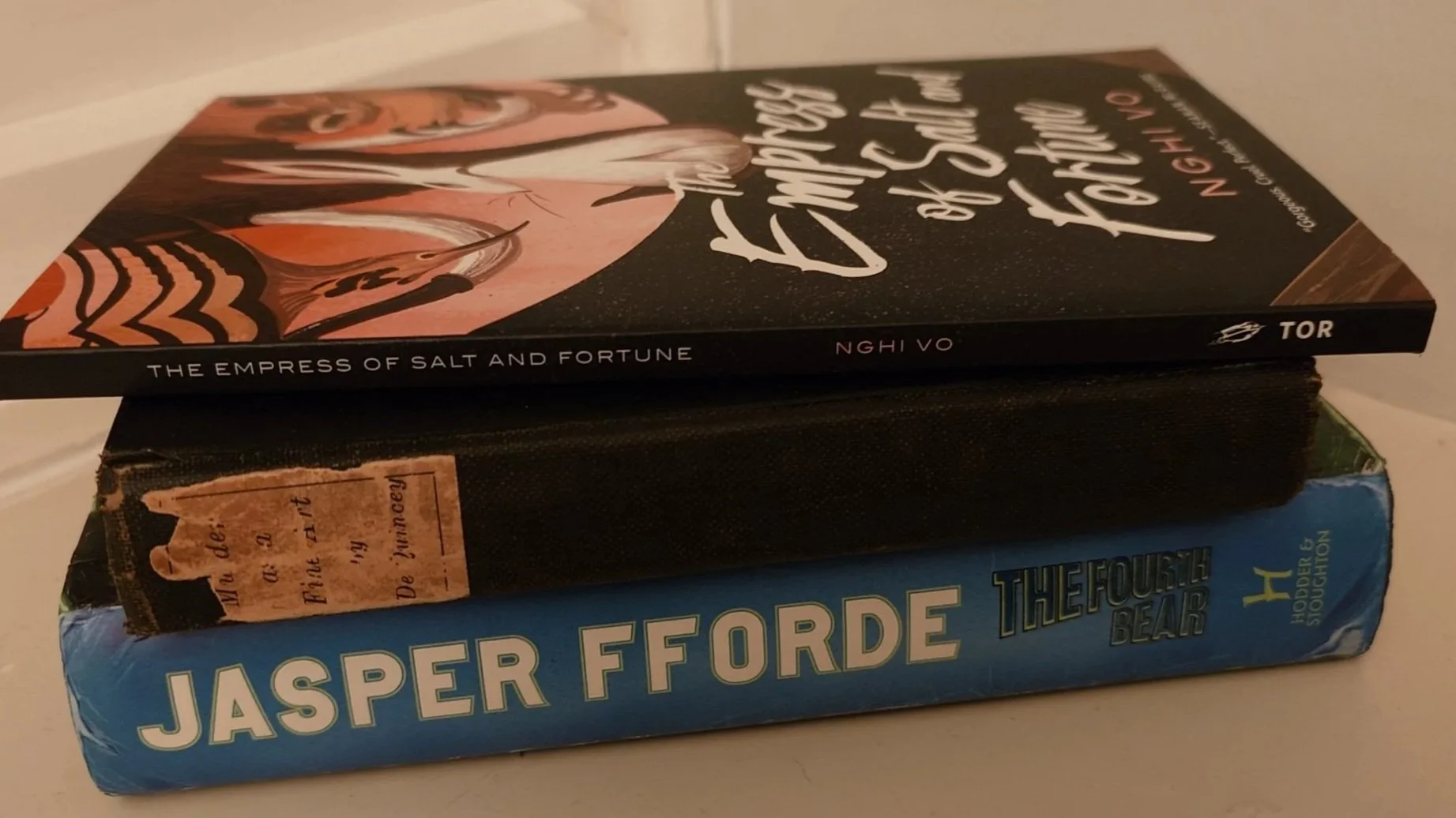
On Murder Considered as One of the Fine Arts - Thomas de Quincey
I’m going to put my cards on the table straight away: this is a re-read, and this book is much, much stranger than I remember.
“...against Locke’s philosophy, in particular, I think it an unanswerable objection (if we needed any), that although he carried his throat about with him in this world for seventy-two years, no man ever condescended to cut it.”
On Murder Considered as One of the Fine Arts contains three essays. The first is presented as the transcript of a speech given to “The Society of Connoisseurs in Murder”. It includes a brief history of murder (beginning with Cain), and a dissection of some “recent” (at time of writing, in the early nineteenth century) murders. The cases are weighed and measured for aesthetic merits and virtues; the murderers’ choices are critiqued, praised, or mocked. The essay also includes a special section on the murder of philosophers (with reference to their respective philosophies) - in fact, I’ve seen the whole thing described as “a prolonged satire of Kant's aesthetic theory”, and I worry that some of the finer points might have whizzed right over my head.
The second essay is a defence of the first, with lengthy detours into the reaction of The Society as a whole (and one member in particular) to the Ratcliffe Highway murders. The third is a straight-up true crime account (though not, according to Wikipedia, an especially accurate one) of those same murders.
It is somewhat worrying to note that when I bought this book (in a long-gone second-hand bookshop in Hastings) and read it for the first time, I couldn’t easily look up the Ratcliffe Highway murders, because Wikipedia had not yet been invented.
I remember this book as being very funny - and parts of it are. The author, however, does have that maddening tendency of nineteenth-century writers to assume that his readers can all follow his erudition effortlessly, and he sprinkles Latin, Greek and French quotations liberally without translation. I looked some of them up, then lost patience. In general, the writing style veers around between turgid and outright silly, passing all stations in between, and I didn’t enjoy it as much as I remember doing the previous time.
The Empress of Salt and Fortune - Nghi Vo
I am pretty sure that this was a gift, and I’m embarrassed to note that I have forgotten from whom.
“Her hair was cropped close to her head like a nun’s, but she’d cut strange patterns into it like sheared velvet, and her eyes were as narrow as her smile was wide.”
Being a novella, it’s a quick read - but is absolutely delightful.
The story gives almost no background before we are suddenly in right there, with a cleric who is collecting stories of a dead empress from one of the empress’ servants. In each chapter, we hear a little of what the cleric is up to in the here-and-now, then we slide into yet another of Rabbit’s tales of the former empress.
Without that background, the reader is left to put together the pieces of the story themselves - and it’s impressive that the whole thing still feels satisfying, and I never felt “lost” in the loose, disjointed narrative.
The culture is not precisely defined, but seems to borrow elements from various real-world Asian cultures, with a hefty dose of fantasy and magic mixed in. The writing is beautiful, and very direct, with very vivid descriptions conjured up from tiny phrases.
This novella feels like a small, polished jewel - and will definitely bear a re-read.
The Fourth Bear - Jasper Fforde
“Take a step closer and my associate hiding over there will tranq your fuzzy butt and we can talk it over at the station. Me with a cup of tea and a chocolate digestive, and you with a splitting headache and a numb arse. Your choice.”
I have been extremely busy during April, both in my day-job and in my real life. Towards the end of the month I had got to the point of wanting something very undemanding to read.
In steps Jasper Fforde.
I’ve read (and enjoyed) some of his Thursday Next books, but this is from the Nursery Crime series, in which DCI Jack Spratt investigates crimes involving Persons of Dubious Reality. It is, however, set loosely in the same world as Thursday Next - which has the added bonus that most of the magic- and mayhem-riddled action takes place in Reading. I worked in Reading for more than a decade, and while murderous nursery rhyme characters are already quite funny, they’re much funnier when they’re rampaging through, say, the Oracle shopping centre.
There is, in general, something quite endearing about Jasper Fforde novels. They’re deeply silly, and they know it. The characters occasionally address the reader directly, the plot cheerfully filches devices from all over the place (and takes them to extremes), and poor old Jack Spratt constantly has to battle government bureaucracy, circumvent department funding problems, and keep his case from straying too far into noir pastiche.
I think it would easily be possible to have too much of this sort of thing, but a little bit when required is just the ticket.